
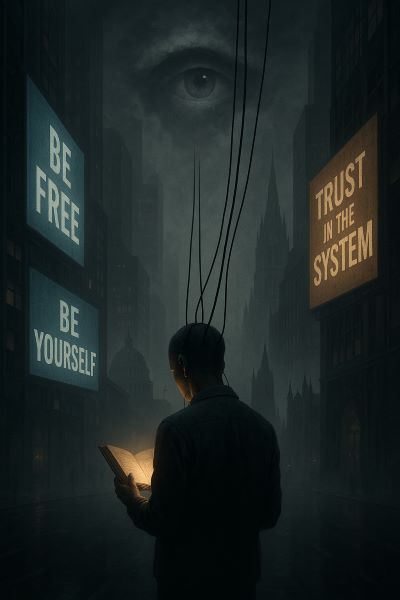
We live in an age where chains are invisible but deeply felt. Where the bars are not made of iron, but of prefabricated ideas, hollow political promises, and dreams imposed by dominant narratives that, far from liberating, sedate. The modern citizen, constantly bombarded by stimuli, fashionable ideologies, and designed values, faces an existential paradox: they believe themselves to be free, yet they follow scripts they never wrote.
At the heart of this phenomenon lies a machinery of control so refined that it no longer needs brute force. Its power does not reside in tanks or prisons, but in symbols, algorithms, speeches, TV programs, and self-help books. The structure of modern submission does not impose—it seduces. It does not forbid—it persuades. And that is its greatest strength.
Educational systems, media outlets, religious institutions, the entertainment industry, and political rhetoric do not merely inform—they shape. They tell you what is desirable, what is morally acceptable, what to think about yourself and about the world. Through this social design, the individual is trained to obey without feeling obedient. They are convinced that their freedom lies in choosing between options already curated by others.
This phenomenon is clearly visible in the rise of ideological movements that promise “personal transformation” or “national renewal,” but are ultimately closed systems that simply replace one form of submission with another. Examples abound: coaching programs that promise absolute happiness in exchange for blind obedience; political parties that channel the people’s legitimate discontent only to preserve traditional elites under renewed rhetoric. The citizen, believing they are breaking their chains, merely changes masters.
The dominant discourse has also colonized history. Complex events are simplified into official narratives that serve the current power. Monuments, national holidays, banknotes, national emblems—all are loaded with symbols whose interpretation is managed from above. A single narrative is thus constructed, one that discourages deep questioning. Those who doubt are marginalized. Those who comply are rewarded with belonging, status, or prefabricated inner peace.
But all is not lost.
Amid this sophisticated ideological control lies an ethical and vital reserve yet to be tapped: ordinary citizens. Those who—far from cameras, forums, and summits—sustain the very structure of society through daily effort. They are public service workers, caregivers, educators, neighbors who self-organize without waiting for orders. In them lies a forgotten, almost mythological power capable of altering the course of history if awakened: the sovereignty of common sense.
The awakening will not be spectacular or televised. It begins with simple questions: Why do I believe what I believe? Who benefits from my fear? What values guide my decisions? How many of my choices are truly mine?
Classic cinema has portrayed this with striking clarity. The Matrix, for example, depicts a society trapped in a digital illusion as pleasing as it is unreal. V for Vendetta shows how a totalitarian regime survives thanks to widespread apathy and media manipulation—until one individual reclaims their moral agency. And in 1984, surveillance and Newspeak are merely amplified reflections of our own modern structures.
Literature has long warned us, too. In The Picture of Dorian Gray, we see how obsession with public image can corrupt the soul. In Fahrenheit 451, books are not only destroyed by political censorship, but by the masses’ unwillingness to be disturbed by uncomfortable thoughts. And, in The Trial, Kafka reminds us of the absurd opacity of institutional power—faceless and bound by no clear law.
The lesson is simple but urgent: if we don’t think for ourselves, someone else will do it for us. And that “someone” rarely acts in our best interest.
This editorial is not a call to paranoia, but an invitation to discernment. To read beyond the headlines. To question the obvious, calmly and rationally. To reclaim critical thinking as an act of resistance. Because as long as the majority continues to accept without questioning, true power will keep operating in the shadows—shaping not only our decisions, but also our beliefs, our dreams, and our defeats.
History does not change because leaders change. It changes when collective consciousness does. And that change always begins with one individual bold enough to see what others prefer to ignore.



Deja una respuesta